The Eucharistic Miracles
Following Christ's instruction during the last supper when he offered the bread as His body and the wine as His blood, Catholic faith teaches that during the consecration at Mass, the bread the priest offers turns into the body of christ and the wine turns into His blood. Over the centuries, at various points and at different places, the consecrated host emits red substance that are scientifically proven to be human blood and, in the cases where the host turns into fleshly tissue, they are analyzed scientifically and discovered to be real human flesh. Here on this page, we have presented some of the known Eucharistic miracles.
The Eucharistic miracle of Sokółka Poland
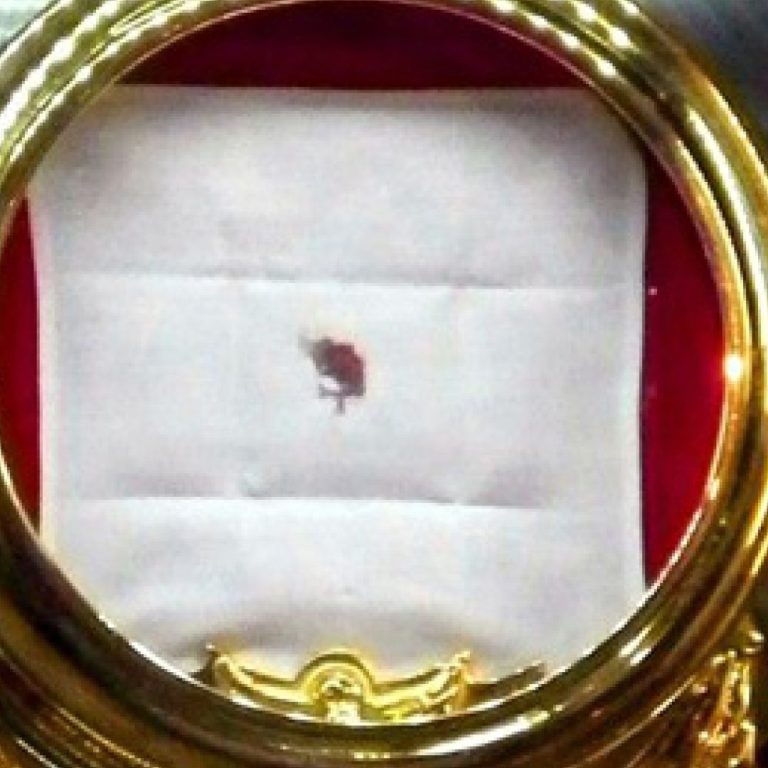
The Eucharistic miracle of Sokółka is a widely discussed event within the Catholic Church that took place in Sokółka in 2008.
On October 12, 2008, during Mass at St. Anthony of Padua Church, a consecrated host (the Eucharist) was accidentally dropped. Following Catholic practice, the host was placed in water to dissolve. After several days, a red stain appeared on the host, which observers said resembled blood or tissue.
The local archbishop, Edward Ozorowski, initiated an inquiry. Two independent medical experts, Maria Elżbieta Sobaniec-Łotowska and Stanisław Sulkowski examined the sample. Their reported conclusion was that the material had characteristics consistent with human heart muscle tissue under stress (similar to myocardial tissue).
In 2009, the archdiocese stated that the event had “a supernatural character,” while stopping short of issuing a definitive dogmatic declaration. The Vatican did not make a universal pronouncement but allowed local veneration. The host is preserved and displayed for veneration in Sokółka. The site has since become a place of pilgrimage for many Catholics.
Eucharistic Miracle of Tixtla, Mexico
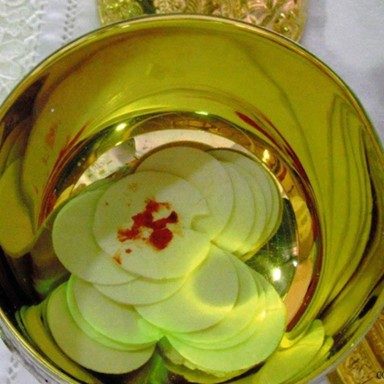
The Eucharistic Miracle of Tixtla, Mexico is one of the most discussed modern Catholic known Eucharistic miracles. On October 21, 2006, at the Parish of St. Martin of Tours, Tixtla, Guerrero, Mexico, during a Mass retreat with about 600 people, a consecrated Host (Holy Communion) began to emit a reddish substance resembling blood while being distributed by a nun. The priests present preserved the Host and reported the event to the local bishop.
Between 2009–2012, the diocese commissioned scientific studies on the sacred host. The red substance was identified as human blood (type AB). Microscopic analysis reportedly found the presence of Red and white blood cells, Macrophages (immune cells). Tissue identified as heart muscle (myocardium). The blood appeared to come from inside the Host, not applied externally. Parts of the sample showed characteristics of living tissue.
In 2013, Bishop Alejo Zavala Castro declared the event a “divine sign” after investigation.
The miracle is recognized locally (diocese level). It has not been officially approved by the Holy See.
The Eucharist is the change of bread and wine to the and Blood of Christ (Transubstantiation). Eucharistic miracles are seen as extraordinary signs to strengthen the faith.
Eucharistic Miracle of Buenos Aires
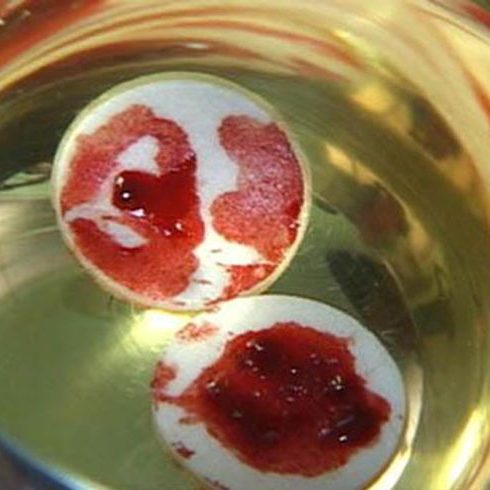
On August 18, 1996, in a parish church in Buenos Aires, a consecrated Host (the Eucharist) was reportedly found discarded on the floor. According to Catholic practice, instead of throwing it away, it was placed in water to dissolve. Over the following days, the Host reportedly did not dissolve but instead appeared to transform into a substance resembling bloody tissue.
Years later, Church authorities had the substance analyzed. The samples were reportedly examined by scientists (without being told their origin), including a lab in the United States, a cardiologist and a forensic pathologist. The results, according to reports, indicated that the material was human tissue, specifically heart muscle (myocardium). It showed signs of inflammation, suggesting the person from whose heart the tissue came had suffered many blows. The blood type was identified as AB. These findings have been widely circulated in Catholic circles as supporting the miraculous nature of the event.
At the time of the events, the Archbishop of Buenos Aires was Pope Francis. He authorized the investigation into the phenomenon before later becoming the Pope.
In Catholic belief, the Eucharist is already the Body and Blood of Christ (a doctrine called Transubstantiation), when the bread turns into the body of Christ and the wine turns into the blood of Christ. Eucharistic miracles like this are seen as extraordinary signs meant to strengthen faith.
The Argentine Eucharistic miracle is one of the most discussed modern claims of its kind. For believers, it reinforces core Catholic teachings.
The Eucharistic Miracle of Lanciano
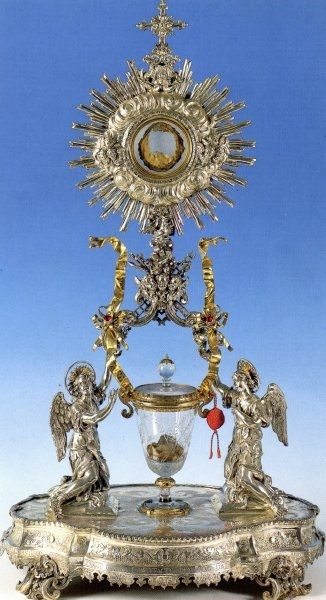
The Eucharistic Miracle of Lanciano is one of the most famous reported miracles in Catholic tradition. It occurred in the 8th century in the town of Lanciano.
The story
A Basilian monk who doubted the doctrine of the Transubstantiation—the belief that bread and wine become the body and blood of Christ during consecration done by a Catholic priest—was celebrating Mass. During the consecration, the bread (host) turned into visible flesh and the wine turned into visible blood, forming five globules. The monk was said to have overcome his doubts after witnessing this.
The relics are still preserved in Lanciano. The flesh is kept as a small piece of tissue while the blood appears as five irregular clots. They are preserved at the Church of San Francesco.
Scientific investigations
In the 1970s, studies were conducted on the tissue and the blood by Italian scientist Odoardo Linoli. The flesh was identified as human heart tissue and the blood was identified as human blood type AB. No preservatives were found present in the species. This is considered without any doubt to be clear evidence of authenticity. The miracle is seen as a powerful affirmation of true presence of Jesus in the Eucharist. There are other reported Eucharistic miracles that have taken place in the Catholic Church that reinforce the faith in Christ’s real presence.
Eucharistic Miracle of Bolsena–Orvieto
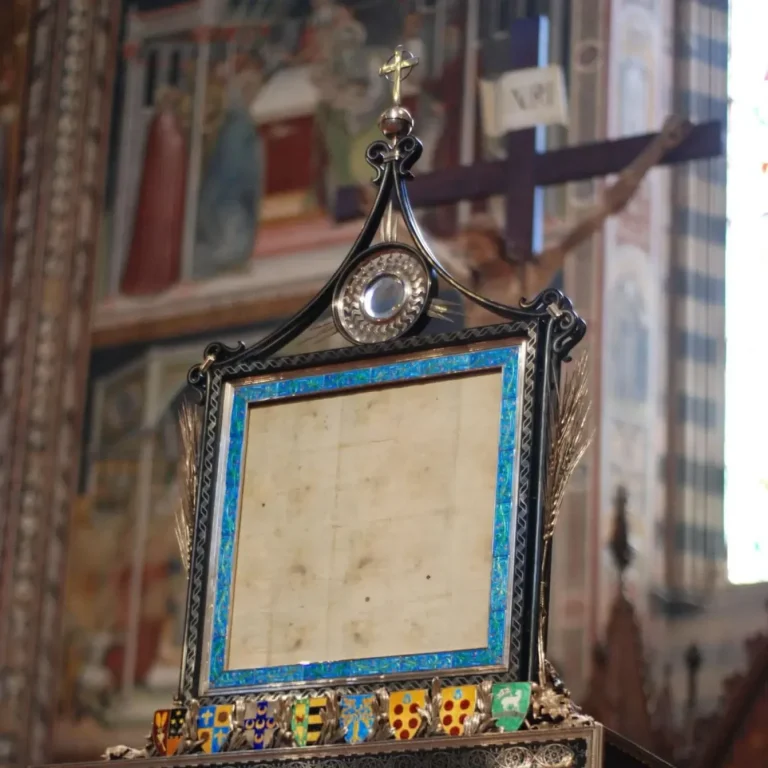
The Eucharistic Miracle of Bolsena–Orvieto is one of the most famous miracles in Catholic tradition, dating back to the 13th century and closely tied to the doctrine of the Real Presence.
Around 1263, a German priest—often identified as Peter of Prague—was struggling with doubts about whether Christ was truly present in the Eucharist. While celebrating Mass in the town of Bolsena at the Church of Saint Christina, something extraordinary occurred. As he consecrated the host (the bread used in the Eucharist), it reportedly began to bleed. The blood from the host fell onto the corporal (altar cloth).
At the time, the pope—Pope Urban IV—was staying nearby in Orvieto. The relic (the blood-stained corporal) was brought to him. After an investigation, he declared it a miracle. He ordered the construction of the Orvieto Cathedral to house the relic. Today, the corporal is still preserved there. This miracle had a major influence on Catholicism. It contributed to the establishment of the feast of Corpus Christi in 1264.
The feast celebrates belief in the Eucharist as the true Body and Blood of Christ. For the Catholic faithful, this miracle is seen as a confirmation of faith in the Eucharist, a response to doubt and a powerful symbol of Christ’s presence in the Mass. For historians, it reflects the religious and theological concerns of medieval Europe, especially debates around the nature of the Eucharist.
The Eucharistic Miracle of Santarém
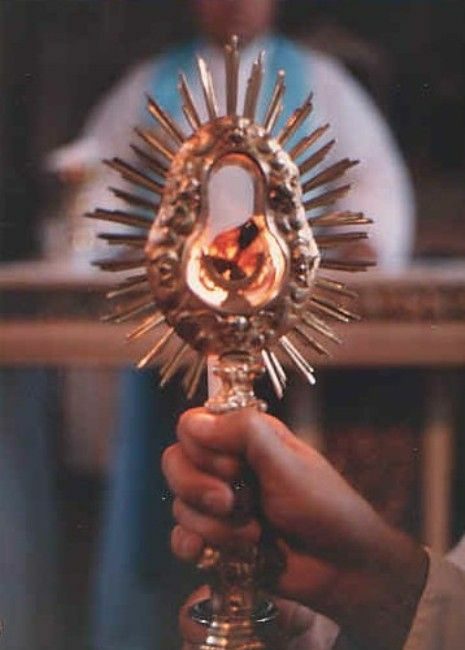
In the 13th century (around 1247), in the town of Santarém in Portugal, a woman, distressed about her marriage, sought help from a sorceress. The sorceress promising to help the woman, asked her to steal a consecrated Host (the Eucharist) from a church and bring to her. After receiving Communion at the church, she secretly removed the Host and placed it in a cloth. On her way home, the Host began to bleed, staining the cloth.
Frightened, the woman, on getting home, hid the Host in a wooden chest in her home. At night, bright light radiated from the chest, illuminating the entire room. She confessed what she did to her husband, and both reported it to the parish priest. The priest retrieved the Host and brought it back to the church in solemn procession.
The Host was placed in a reliquary at the Church of St. Stephen, now known as the Church of the Holy Miracle. Over time, it was observed that the Host continued to appear as flesh and blood. The Catholic Church approved devotion to the miracle after investigation. Like other Eucharistic miracles, the Eucharistic miracle of Santarém is cited as evidence supporting the doctrine of Transubstantiation (that the bread and wine become the Body and Blood of Christ during the consecration).
The Church of the Holy Miracle in Santarém remains a pilgrimage site, attracting visitors from around the world. The relic is still preserved in Santarém, displayed in a beautiful monstrance above the main altar. The town celebrates the miracle annually, and it continues to be one of the most enduring Eucharistic miracles in Catholic tradition.